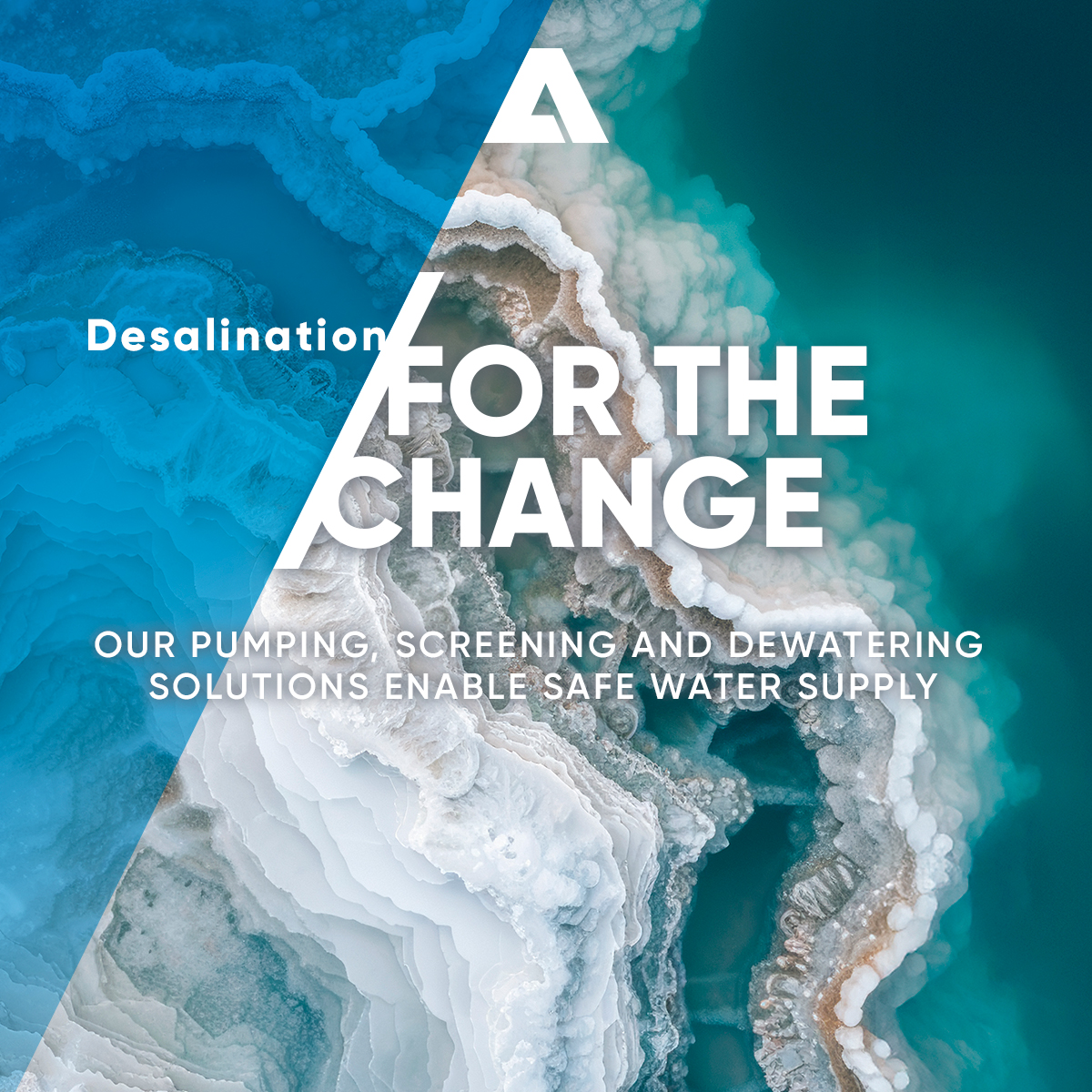
“Water scarcity is a present reality. The challenge is no longer if desalination works, but how to scale it responsibly.”
Jorge Muñagorri
Industry Director Water, Pumps

By 2030, global demand for fresh water is projected to outstrip supply by 40% - a staggering figure that underscores one of the most pressing challenges of our time: water scarcity. As climate change accelerates, populations grow, and industrial and agricultural needs intensify, the availability of clean water is becoming increasingly strained. This megatrend is not confined to arid regions; it is a global phenomenon reshaping how societies think about water access, infrastructure, and sustainability.
Today, over two billion people lack access to safe drinking water, and nearly half the global population experiences water shortages for at least one month a year. These figures, drawn from the UN World Water Development Report and other leading studies, underscore a sobering reality: water scarcity is no longer a distant threat – it is a defining challenge of our time.
Water scarcity is driven by a complex interplay of factors. Climate change is changing rainfall distribution and intensity and accelerating droughts. Because while the total volume of global precipitation hasn't yet changed dramatically, where, when, and how intensely it falls has shifted significantly. Furthermore, rapid urbanization and population growth are increasing demand, while aging infrastructure and poor water governance exacerbate the problem.
In many regions, groundwater is being depleted faster than it can be replenished. Meanwhile, pollution from industry, agriculture, and domestic sources continues to degrade the quality of available freshwater. The result is a growing “water gap”: a mismatch between supply and demand that threatens food security, economic development, and social stability.
While freshwater makes up only 2.5% of the Earth’s water – and less than 1% is readily accessible for human use – nearly 80% of the world’s population lives near coastlines. This proximity to seawater presents a compelling opportunity: Desalination.
This process, wich removes salt and impurities from sea or brackish water, has become a necessity to provide fresh water to many coastal cities and water stressed regions.
Since oceans cover over 70% of the Earth’s surface, desalination offers access to an almost limitless water source. Countries like Saudi Arabia and Australia have already integrated desalination into their national water strategies. Notably, cities outside traditional desalination hubs are now joining the trend: Hong Kong’s first municipal reverse osmosis (RO) plant at Tseung Kwan O came online in December 2023 with a capacity of 135,000 m³/day, adding a climate-resilient water supply to a dense urban system.
Jorge Muñagorri
Industry Director Water, Pumps
Historically, desalination has been energy-intensive and costly while the environmental footprint of desalination – particularly brine disposal and marine ecosystem disruption – has been a concern. However, recent innovations in brine treatment and salt recovery are helping mitigate these effects and are changing the landscape as they reduce environmental impact and lower operational costs.
Solar-powered desalination plants, zero-liquid discharge systems, and circular water reuse models are emerging as promising pathways. The World Economic Forum and other global institutions now recognize desalination as a key technology in climate adaptation and water security strategies.
At ANDRITZ, we provide efficient and reliable technologies which are key components of desalination plants.
Our centrifugal pumps are designed for seawater desalination applications, particularly for Reverse Osmosis (RO) plants. We offer main pumps for the seawater intake, pretreatment and high-pressure stages, as well as the secondary pumps for water transport, and backwashing. Our pumps, made from duplex and super duplex stainless steel, resist corrosion and erosion - ensuring the highest efficiency on the market and minimizing maintenance.
In addition, water intake is a key process step where water taken out of the environment must be first filtered before it is processed. Our range of screens, for both onshore and offshore applications, is designed to minimize headloss, deliver a high debris capture rate, and ensure the protection of aquatic life, particularly in compliance with fish protection regulations.
Finally, at the back end of the process, the sludge, residue of the water treatment, must be managed. Our dewatering technologies are specially designed to handle this highly corrosive and abrasive slurry.
With this portfolio of proven technologies, we, at ANDRITZ, are supporting the industry in making desalination a performing and cost-efficient process to produce fresh water. We proudly contribute turning seawater into a secure resource for communities and industries worldwide.
Loïc Lebègue
Industry Director Environment, Separation
Water scarcity is not a distant threat – it is a present reality. Desalination offers a powerful response, but its success depends on continued innovation, cross-sector collaboration, and a commitment to equitable access. As we navigate this megatrend, the question is not whether we can desalinate more water, but if we can do so responsibly, sustainably, and inclusively.
In the face of rising demand and dwindling supply, turning seawater into fresh water is a necessary evolution. And with science, policy, and industry aligned, we have the tools to turn the tide.

Our extensive product portfolio covers a spectrum of technologies ranging from mechanical and thermal solid/liquid separation, grinding, pelletizing, pumping fluids, emission reduction technologies, carbon capture, to green hydrogen and renewable fuel production.
ANDRITZ Separation is the world’s leading separation specialist, with the deepest knowledge, broadest technical resources, and most comprehensive service solutions.

ANDRITZ offers an extensive line of equipment and complete plant solutions for the production of high-quality feed and biomass products.

Our engineered pumps are operating in various industrial applications successfully all over the world. They offer robustness and wear resistance and fulfill highest customer expectations in terms of efficiency, life cycle, maintenance friendliness and economic efficiency.
We provide you with tailor-made air pollution control solutions focusing on reduced emissions and improved performance and efficiency to meet changing market conditions and comply with asset strategies. Our offering covers the entire flue gas line, ranging from particulate control, dry and wet scrubbers, to multi-pollutant equipment for industrial, waste-to-energy and power generation plants.
ANDRITZ provides holistic and integrated P2X solutions for producing green hydrogen, e-methanol and e-ammonia.
Welcome to our Tradeshows & Events page! Here you'll find a selection of our key tradeshow participations of this year.