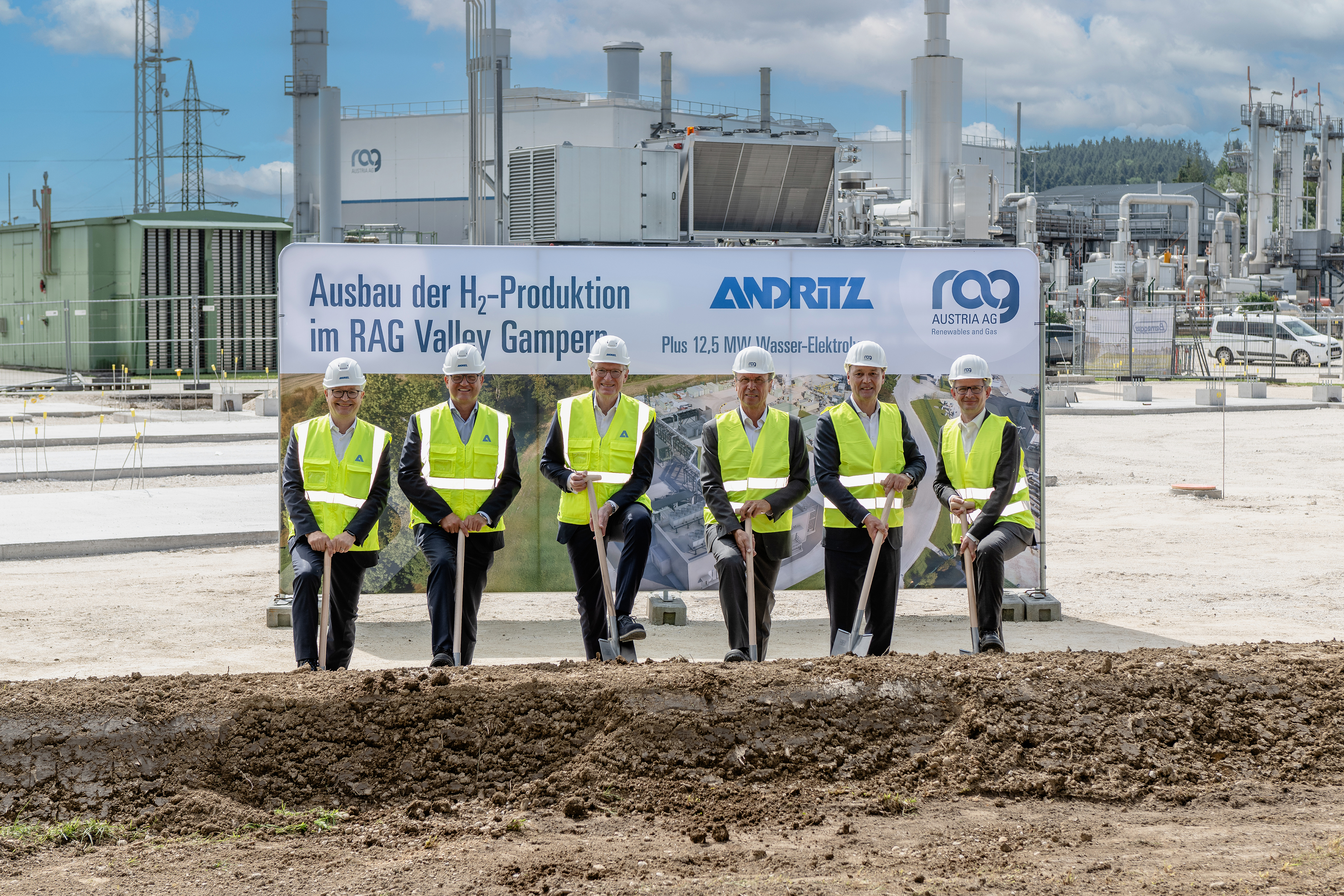
Spatenstich_Copyright_KarinLohbergerPhotography

RAG Austria and ANDRITZ celebrate groundbreaking for Austria’s largest green hydrogen project

2026/07/08

International technology group ANDRITZ and RAG Austria AG, a leading energy storage company, have officially marked the start of construction with a groundbreaking ceremony for Austria’s largest green hydrogen plant.

The 12.5 MW facility will help store surplus renewable energy generated in the summer for use during periods of high energy demand, particularly in winter, thereby enhancing energy security, supporting the continued expansion of renewable energy and providing green hydrogen for industrial needs.

ANDRITZ will deliver the plant on an EPC basis, taking full responsibility for project execution and commissioning. Scheduled to start operation in the end of 2026, the facility will produce around 17 million m³ (more than 1,500 tons) of green hydrogen annually using solar power as its primary renewable energy source. Upon commissioning, it will be the largest green hydrogen facility in Austria. The project addresses one of the central challenges of the energy transition: storing renewable energy when it is abundant for use when demand is highest, while ensuring a continuous and reliable supply of indigenous green hydrogen for industry. By converting surplus solar power generated in summer into green hydrogen, the plant will enable RAG Austria to create large-scale seasonal energy storage, making renewable energy available for electricity and heat production in winter.

“In light of rising demand of green hydrogen in industry as well as in heating and power generation, particularly in winter, it is essential that Europe now begins producing its own hydrogen and consistently leverages available surplus electricity resources. Around half of future demand will need to be met within Europe, making it imperative to act now,” says Markus Mitteregger, CEO of RAG Austria.

ANDRITZ’s scope of supply includes the complete green hydrogen production plant, as well as systems for hydrogen purification and compression.

The project further strengthens ANDRITZ’s position as a leading EPC partner for green hydrogen plants and supports the company’s strategic focus on technologies that enable the green transition. 

– End –

From left: Sami Pelkonen (EVP, Green Hydrogen ANDRITZ AG), Dietmar Heinisser (Executive Board Member, Environment and Energy ANDRITZ AG), Joachim Schönbeck (CEO ANDRITZ AG), Markus Mitteregger (CEO RAG Austria AG), Robert Dick (CFO RAG Austria AG), Stephan Bauer (Green Gas Technologies RAG Austria AG)

© Karin Lohberger Photography

ANDRITZ GROUP
International technology group ANDRITZ provides advanced plants, equipment, services, and digital solutions for a wide range of industries, including pulp and paper, metals, hydropower, environmental, and others. Founded in 1852 and headquartered in Austria, the publicly listed group employs about 30,000 people at 280 locations in over 80 countries.

As a global leader in technology and innovation, ANDRITZ is committed to fostering progress that benefits customers, partners, employees, society, and the environment. The company’s growth is driven by sustainable solutions enabling the green transition, advanced digitalization for highest industrial performance, and comprehensive services that maximize the value of customers’ plants over their entire life cycle. ANDRITZ. FOR GROWTH THAT MATTERS.

ANDRITZ ENVIRONMENT & ENERGY
ANDRITZ Environment & Energy is committed to environmental responsibility and offers a broad range of technologies focusing on sustainable solutions for various industries. The extensive product portfolio includes technologies for the production of green hydrogen and renewable fuels, for carbon capture and emission reduction, mechanical and thermal solid/liquid separation, grinding, pelletizing, and for pumping fluids. Complemented by cutting-edge automation and digitalization as well as comprehensive services, they enable efficient and innovative solutions in processes such as water and wastewater management, recycling, waste/sludge-to-value, resource-saving battery-related mining, desalination, feed and food valorization, air emission reduction and P2X.