AdobeStock_892464080

Early engineering consultancy for P2X plants

Tailored engineering and consultancy services

Developing a successful Power-to-X (P2X) project starts with making the right decisions early. Whether you're evaluating project feasibility, building a robust business case, or preparing for EPC tendering, a structured early engineering approach provides the confidence to move your project forward.

ANDRITZ supports you through every stage of early engineering with planning and feasibility studies that lay the foundation for sound business case evaluations and successful project execution.

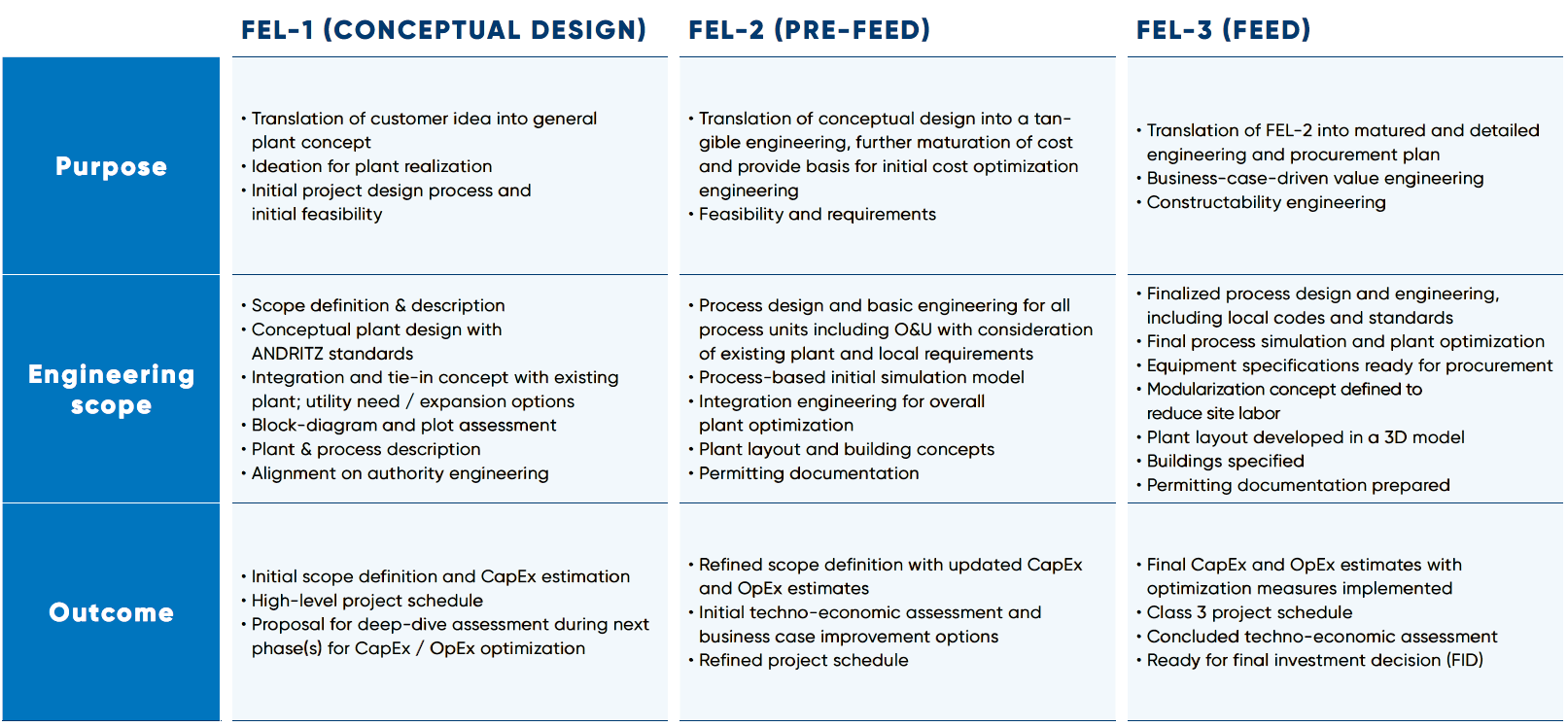
Our early engineering approach is structured into three distinct phases, each with a clear purpose, defined scope, and tangible deliverables—providing the technical foundation for robust business case assessments and confident Final Investment Decisions (FID).

Helping you make confident decisions with early-stage cost and technology insights

Proven insight into P2X technologies   

We bring hands-on insight into the technologies that power P2X plants. We know how systems like electrolyzers, carbon capturing, synthesis units, and gas treatment processes perform—not just in theory, but in real-world operation. This allows us to create practical, efficient designs tailored to your project’s goals from day one, even under intermittent power load profiles.


EPC expertise with a deep understanding of execution costs

ANDRITZ brings EPC expertise and a clear understanding of real-world execution costs. Our insights into procurement and construction realities ensure cost estimates that reflect market conditions. This strengthens your business case and supports confident early-stage decisions. 

Integration engineering for optimal value chain

With our integration engineering services your plants benefit from optimizing the full value chain. We consider various factors such as LCOE (levelized cost of electricity) optimization, green hydrogen demand-driven operation, additional revenues from by-product use, cost base improvement, and additional funding opportunities. Our goal is to enhance the efficiency and profitability of your project. 


ANDRITZ engineering consulting approach

Customer proximity, globally from the start 

Nobody can do it alone —together, we tackle today's challenges with precise and responsive communication. 
With a presence in 280 locations worldwide, we can efficiently build P2X solutions wherever you want to build the plant.

Contact us

Understanding of project viability requirements 

To make P2X projects viable, special attention must be given to intermittent power load profiles. Our approach includes LCOP (levelized cost of product) reduction, product and by-product demand-driven operation optimization, additional revenues from by-product use, cost base improvement, and leveraging EU funding for innovative projects. 

Additionally, our plant concepts reflect the best scaling and process integration for an optimum of the levelized cost of product. For this we offer a holistic process simulation, from the input of the electron to the output of the targeted product(s). 

Key deliverables 

In the FEL-1 and FEL-2 phases, we translate customer ideas into project scopes, prepare process diagrams, estimate costs, and align with engineering requirements.  

During these phases, we help you understanding the differences and advantages of technology options. During the final FEL-3 phase, we complete process simulations, finalize engineering datasheets, prepare equipment procurement inquiries, and refine cost estimates. 

At all stages we align the need for permitting requirements and deliver accordant documents, e.g. environmental impact analysis. 

ANDRITZ Power-to-X consulting supports companies throughout the development of green hydrogen and e-fuels projects across the full project life cycle, from concept development through the FID decision.

This includes feasibility studies, technology selection, system and plant integration, flexible operation based on renewable energy availability, site assessment, regulatory analysis, CAPEX/OPEX evaluation, funding opportunity assessment, financing support, and implementation planning.

A key focus from the earliest project phase is optimizing the Levelized Cost of Product (LCOP) through efficient process and technology integration. In Europe, our consulting services also help projects align with evolving EU regulations (e.g. RFNBO requirements).

A feasibility assessment evaluates technical and commercial factors such as renewable electricity availability (load factors), water access, CO₂ sources, infrastructure, technology options, and market demand. 

Since electricity consumption is typically the largest operating cost, understanding its impact on the Levelized Cost of Product (LCOP) from the outset is critical. To optimize project economics and LCOP, all relevant factors are analyzed, including: 

  • Electricity pricing (per hour) 

  • Full process integration from “electricity-in” to “end-product-out”, with consideration of mass- & energy-balances of all process units, and optimization under the flexible operational regime 

  • Investigation of utility synergies and hydrogen / e-fuels production costs under transient conditions 

  • Offtake requirements. 

These analyses are used to determine the optimal plant configuration for the specific project conditions and develop a fit-for-purpose solution with long-term project viability and bankability in mind. 

To support this work, ANDRITZ has developed its own techno-economic optimizer, enabling these factors to be assessed under project-specific plant conditions.

The economic viability of a Power-to-X (P2X) project is primarily driven by renewable electricity availability, which determines electrolyzer utilization rates, and electricity prices, as electricity consumption is typically the largest operating cost in green hydrogen and e-fuels production. Local grid requirements also often play an important role.

In addition, achieving a competitive Levelized Cost of Product (LCOP) depends on the efficiency of the electrolysis equipment, which varies with load factors, plant scale (due to economies of scale for central supply and process units), smart process integration, particularly under transient operating conditions, CO₂ sourcing, collocation with process and heat integration, infrastructure availability, and product demand requirements.

Optimizing both CAPEX and OPEX from the earliest project stages is essential to building a viable Power-to-X business case. In Europe, policy incentives, carbon pricing, and secure offtake agreements can further improve investment attractiveness.

Power-to-X (P2X) technologies can be integrated into existing industrial operations to support decarbonization and reduce dependence on fossil fuels. 

The simplest application is the substitution of grey hydrogen with green hydrogen without requiring further changes to the existing value chain, such as in refineries. This can be achieved by installing a dedicated electrolysis plant near the point of use or by connecting the industrial plant to a dedicated hydrogen pipeline, as envisioned by the European Hydrogen Backbone. In the latter case, the points of production and demand are decoupled, allowing the electrolysis plant to be located where renewable electricity conditions are most favorable. 

When integrating a P2X plant into an existing industrial facility, effective process and technology integration help optimize energy efficiency, infrastructure utilization, and overall Levelized Cost of Product (LCOP). Brownfield integration requires consideration of several project-specific aspects, making it an important focus of early engineering studies. Common applications include green hydrogen for steelmaking, e-methanol for the chemical and shipping industries, and e-ammonia for fertilizer production. 

Premature technology selection, insufficient FEL study work and a lack of involvement from a technology-knowledgeable EPC contractor with a proven Power-to-X (P2X) track record, are among the main reasons projects fail, as the risk of overlooking critical integration aspects is high. 

Other risks include regulatory uncertainty, technology integration challenges resulting from the involvement of too many parties without an experienced system integrator, and the still-developing market for green hydrogen and e-fuels, particularly regarding offtake conditions. 

Since Power-to-X (P2X) business cases often operate with limited economic margins, careful consideration of all project-specific factors, true technology and process integration, and comprehensive EPC expertise are essential for optimizing both CAPEX and OPEX from the very start of the project, beginning with the early engineering phases. Technology-focused engineering studies, combined with experienced project partners, help reduce technical, financial, and operational risks throughout the project lifecycle. 

The main European directives and regulations governing Power-to-X (P2X) and green hydrogen are RED III, FuelEU Maritime, and ReFuelEU Aviation. These frameworks define quotas and targets for, among other things, Renewable Fuels of Non-Biological Origin (RFNBO), which must be met by the relevant obligated parties.

To comply with these directives and regulations, producers of green hydrogen and e-fuels must undergo certification processes.

Another important set of requirements is defined in the RED III Delegated Acts, which require operators of electrolysis-based hydrogen plants to comply with the three criteria of Additionality, Temporal Correlation, and Geographic (Regional) Correlation. To demonstrate compliance, appropriate metering and monitoring systems must be in place. The EPC contractor should therefore provide the required metering infrastructure and supporting software.

Compliance with these requirements is verified through certification, which must be renewed periodically.

Project costs can be reduced through optimized plant design, modular solutions, economies of scale for central utility and process units, and high electrolyzer utilization. When multiple technologies and process plants must be combined and integrated (e.g. in Power-to-X projects for e-fuels), compact layouts, efficient process integration, and utility synergies also play an important role. Additional cost savings can be achieved through aligned sourcing strategies that optimize purchasing conditions and create synergies in spare parts and material classes.

Selecting the right technologies and integrating renewable energy effectively can significantly reduce long-term operating costs and improve overall project performance.

Your trusted partner for P2X

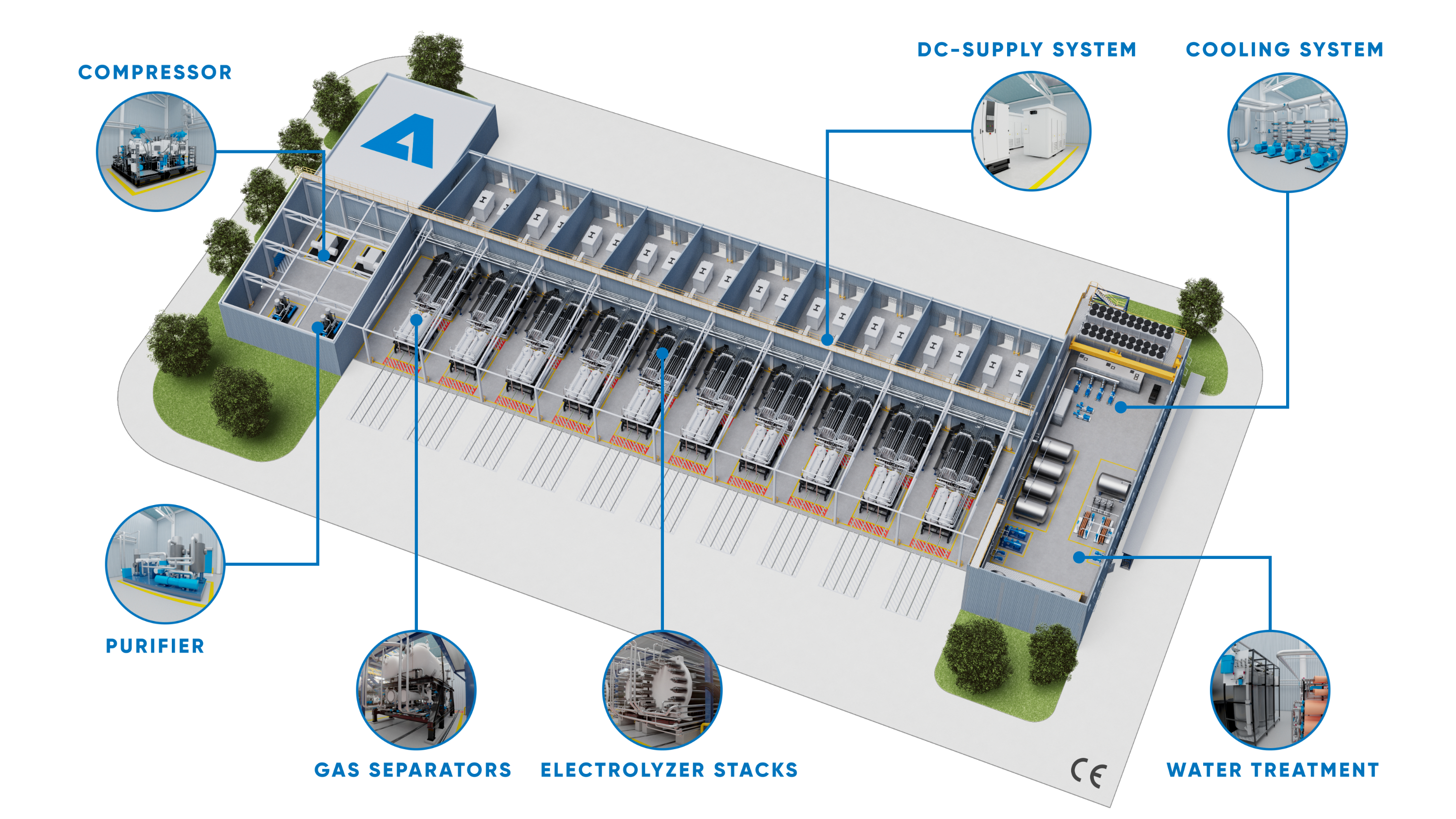
We offer integrated P2X solutions for the production of green hydrogen, e-methanol and e-ammonia, taking responsibility for delivering and integrating the technologies. Our plants are tailored to the customer's needs and site-specific conditions.

ANDRITZ's holistic solutions include

  • Converting an idea into a detailed design and project plan
  • Pre-engineering work (FEL-1 - FEL-3) to fully support the customer's FID (final investment decision)
  • Executing the project plan as EPC (Engineering, Procurement, Construction)
  • Providing LTSA services for the operating plant.

Why ANDRITZ

As a global company with industry-leading technologies, we provide full performance guarantees and life-cycle services for the green hydrogen plants and, as a trusted partner, make your project safe. Our widely distributed manufacturing and service centers offer responsive and reliable local support and resources.

A holistic approach ensures the best results

We provide complete EPC solutions with guarantees and long-term service agreements, addressing all your needs efficiently and cohesively. 


Delivering the plants with performance guarantees

As a solution provider, we utilize proprietary technology, in-house core components and expert integration engineering, allowing us to offer performance guarantees for entire plants. 


Secured investment far into the future

As a stable, global company with over 170 years of history, we secure your green transition investment far into the future. Furthermore, ANDRITZ is a trusted partner that provides performance guarantees for the P2X plants based on measured feedstock and production output. 


Contact us 


Our offering

iStock-1310300600

EPC solutions for green hydrogen production

Converting renewable energy to green hydrogen.

Read more
AdobeStock_261968089

Harness the potential of e-methanol

ANDRITZ provides holistic and integrated solutions to produce e-methanol.

Read more
AdobeStock_491791457

Discover our CO₂ capture technologies

Carbon Capture, Utilization and Storage Solutions

Read more