Andritz-2026-11-EGH-wp-article-heroimage

Choosing the right electrolyzer technology for green hydrogen

Technology decisions have a significant influence on the integration and economics of a P2X project. Narrowing the technology options earlier allows engineering teams to evaluate technology-specific characteristics, optimize process integration and assess performance against the underlying business-case assumptions. The objective is not to eliminate optionality prematurely, but to focus engineering efforts on the most suitable and credible technology pathways.

Narrowing the broad field of technology options

The electrolysis island can represent a significant share of the total capital expenditure (CapEx) of a complex P2X project. Its electricity consumption and resulting Levelized Cost of Hydrogen (LCoH) also have a major influence on the Levelized Cost of Product (LCoP) for hydrogen derivatives such as e-ammonia. This makes electrolysis technology selection an important factor in the overall project economics.

Electrolysis efficiency, CapEx, operating characteristics and integration requirements therefore need to be considered carefully. An earlier technology decision enables these characteristics to be reflected in process integration and optimization, with the Target LCoP as the common economic objective. The question is how to narrow the technology landscape without sacrificing the quality of the selection process.

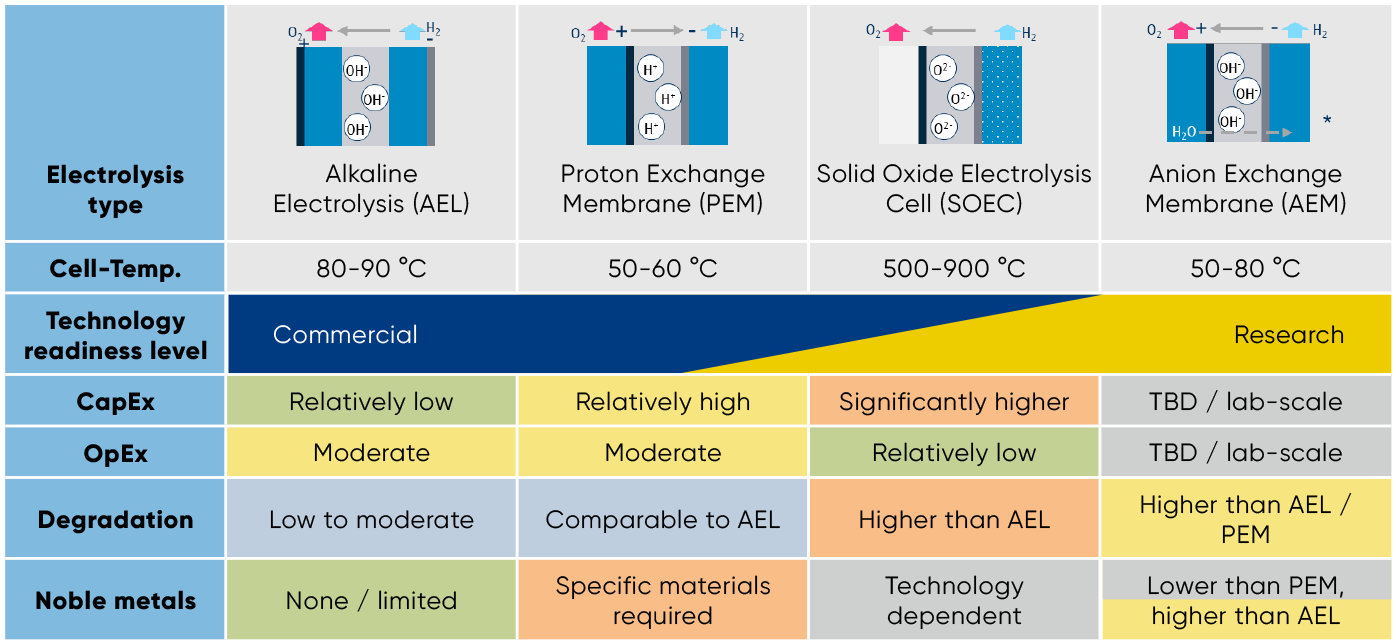
A structured comparison of the available technologies and their respective advantages, limitations and reference base provides a useful starting point. 

Assessing SOEC: Solid oxide electrolysis cells (SOEC) offer potential efficiency advantages, but commercial deployment at scale remains limited. Recent market developments also indicate that some technology providers have adjusted their SOEC commercialization plans. For projects prioritizing proven performance and bankability, it may therefore be appropriate to focus on technologies with a stronger commercial reference base, while continuing to monitor the development of SOEC. 

Assessing AEM: Anion exchange membrane (AEM) electrolysis aims to combine some of the advantages associated with alkaline and PEM technologies. However, commercial eployment at scale remains limited. For projects where proven references and bankability are key selection criteria, AEM may therefore require further evaluation as the technology and its commercial reference base develop.

For many current large-scale P2X developments, alkaline electrolysis (AEL) and proton exchange membrane (PEM) electrolysis therefore represent established options with a growing commercial reference base and a broad range of potential OEMs. Narrowing the technology field at this stage makes it possible to focus the subsequent evaluation on the solutions most likely to meet the technical, economic and bankability requirements of the project.
 

Narrowing down the OEM choices

Technology selection should consider not only technical performance and cost, but also bankability. This includes the robustness and commercial maturity of the technology, the OEM’s ability to stand behind its performance commitments, and confidence in long-term support throughout the plant lifecycle.

The objective in the early development phases should therefore be to narrow the OEM field to credible suppliers that meet the project’s technical, commercial and bankability requirements. The remaining options can then be benchmarked against the business-case criteria established for the project, enabling engineering resources to focus on the solutions with the strongest potential to achieve the Target LCoP. 

How relevant is the pressure level discussion?

During the OEM and technology preselection phase of a P2X project, the advantages and disadvantages of pressurized versus non-pressurized electrolysis are frequently discussed, including their implications for safety and overall project economics.

Electrochemical compression can be more efficient than mechanical compression, particularly when increasing hydrogen pressure from ambient conditions. Integrating compression directly into the electrolysis process can also reduce the need for additional mechanical compression equipment and the associated CapEx and maintenance requirements. However, pressure also influences the design and cost of downstream equipment, including phase separators, piping and gas purification units. The appropriate pressure level should therefore be considered as part of the overall techno-economic optimization of the P2X value chain. 

Typical pressure levels for electrolysis in P2X applications depend on the specific use case, with 15 and 30 barg commonly applied and 35 to 40 barg considered in some applications. The optimum pressure level should reflect the requirements of the downstream processes as well as efficiency, equipment design, CapEx and operational considerations. 

Safety remains fundamental regardless of the selected pressure level. In hydrogen electrolysis, relevant considerations include variations in hydrogen concentration in oxygen under transient operation due to crossover from the cathode to the anode side, as well as the additional design requirements associated with pressurized systems. These phenomena are well understood and should be addressed through good engineering practice, appropriate protection concepts and certified equipment that meets the required Safety Integrity Level (SIL). 

Rather than considering pressurized or non-pressurized electrolysis as universally preferable, the appropriate solution should be determined through a use-case-specific assessment of the complete P2X value chain. The evaluation should consider efficiency, safety, CapEx, maintenance, downstream integration and the resulting Levelized Cost of Hydrogen (LCoH). This holistic approach supports technology selection based on the overall project economics and Target LCoP rather than on a single technology characteristic.

If in doubt, consider a Dual-FEL

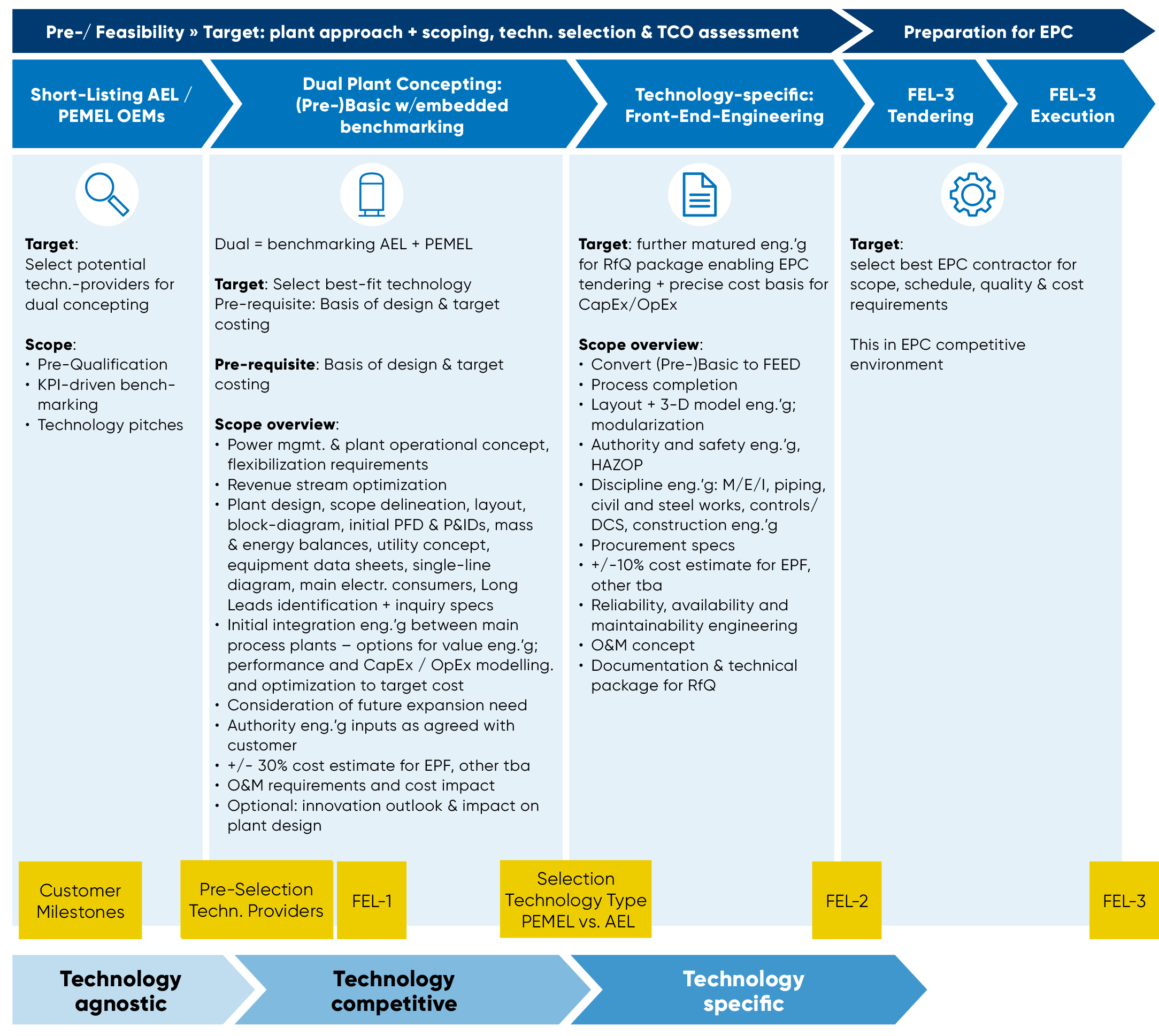
For some P2X projects, the preferred technology pathway may not be clear after the initial preselection. For example, both pressurized alkaline electrolysis (AEL) and pressurized proton exchange membrane (PEM) electrolysis may remain credible options. In such cases, a Dual FEL-1/-2 light approach provides a structured way to compare the alternatives before making the final technology decision

Under this approach, representative solutions for both technologies are developed in parallel. A technology-competent engineering company or EPC provides the engineering basis and evaluates each option against the relevant project requirements, including the Target Levelized Cost of Product (LCoP). This allows the comparison to go beyond individual equipment characteristics and consider how each technology performs as part of the complete P2X value chain.

The objective is to maintain competition and flexibility where they add value, while avoiding an unnecessarily broad technology-open approach throughout several FEL phases. By narrowing the field to a small number of credible, bankable alternatives and evaluating them with sufficient engineering depth, the project developer can make a more informed technology decision and move forward with greater confidence. 

In summary, a Dual FEL approach can provide a practical bridge between technology agnosticism and early technology selection. The focus remains on selecting technologies that can be effectively integrated and optimized for the specific project, with the Target LCoP guiding the evaluation and subsequent engineering decisions.

Bild1

Dual-FEL: decisive shift from agnostic to competitive to specific technology considerations in FEL

ANDRITZ P2X solutions

ANDRITZ responds to the urgent need for decarbonization and green transition. We provide integrated P2X solutions for the production of green hydrogen, e-methanol and e-ammonia — ranging from consulting to EPC projects with full performance guarantees. Our long-term service agreements are based on our proprietary digital solution. 

Explore our solutions

Author

Andreas Rupieper

VP Business and Strategy development P2X