The world´s most comprehensive portfolio of separation technologies.
Evaporators - Revolutionizing industrial processes
Evaporators are devices that are used to remove liquid from a solution or a suspension, by heating the mixture to promote evaporation. They are an essential component of many industrial processes, including chemical, pharmaceutical, food, beverage production, and wastewater treatment industries.
There are different types of industrial evaporators available in the form of shell and tube, plate and frame and thin film. Typically shell and tube evaporator types include falling film, rising film evaporators, and forced circulation. Typically plate and frame evaporator types include rising film and forced circulation. Each type has its unique features and advantages depending on the specific application and process requirements.
In this article, we will discuss:
- Their operating principle, applications, and design considerations,
- The various types of evaporators used in industrial settings,
- What makes them essential for many industries,
- What makes innovators like Dedert a superior choice for evaporation technology.
Working principle of evaporators
Engineers design evaporators based on the physical phenomenon of evaporation, concentrating a solution by converting the volatile liquid into the vapor phase by adding heat energy to the system. The heat source is normally either from condensing or cooling a liquid at a higher temperature and pressure than the solution which is being concentrated.
The basic components of an evaporator are:
- The heat exchanger to transfer the heat from the heat source to the liquid to be concentrated,
- The separator for separating the vapor from any remaining liquid droplets entrained in the vapor,
- The condenser for condensing the vapor produced by the evaporator.
Energy sources of evaporators
The energy sources of evaporators are listed below:
Steam heated evaporators are preferred when low pressure steam is available and inexpensive. The steam is condensed on the shell side of the evaporator, which operates at a higher pressure than on the tube side and drives evaporation. The evaporation from the first effect is used as the heating source for the subsequent effect. The vapors produced in the last effect are condensed in a condenser. Steam cost, overall available temperature differential, space requirements and product characteristics are considered to optimize the number of effects.
Dedert originally introduced mechanical vapor recompression (MVR) to the corn wet milling industry over 50 years ago. The evaporator components are like steam driven systems, but with the addition of a mechanical compressor or fan. Mechanical energy compresses evaporated process vapor to a higher condensing pressure and temperature, and returns it to the process, significantly minimizing steam consumption.
With increased gas prices, MVR has become the popular option for reducing operating costs, especially at higher evaporation rates. Since normally one effect is required, fewer vessels are required than in steam powered multiple effect systems, resulting in lower installation costs.
Thermal vapor recompression (TVR) system is more energy efficient than a steam heated system when medium to high pressure steam is available. The motive steam enters through the nozzles and draws in recycled suction vapor. The vapor mixes in the converging section, and the recycled vapor is boosted to an intermediate pressure. Recycling the suction vapor allows for a lower steam consumption. For further steam reduction, a more efficient thermocompressor is selected and more suction vapor is recycled.
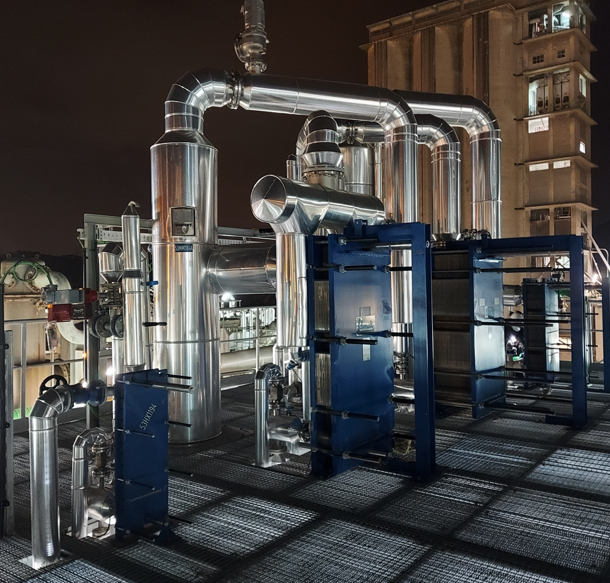
ANDRITZ Dedert thermocompressor evaporator
|
As part of the movement for sustainable future, increased efforts have been made in finding ways to reuse energy from other parts of the plants. We have long been a pioneer in waste heat recovery and was granted the US patent for an evaporator chest with built-in scrubber for a "all in one" solution for the starch industry.
Integrating evaporators to take advantage of the free energy from dryers or distillation columns reduces the plant overall energy consumption and impact on the environment. There is also a reduction in energy requirements for the downstream emissions handling equipment.
An evaporator can use many different energy sources in lieu of steam and Dedert has considerable expertise in making use of otherwise wasted energy sources:
- Waste heat recovery evaporators utilizing exhaust vapor from dryers or other equipment,
- Evaporator system integration with strippers, scrubbers and distillation columns.
- Thermocompressor for boosting low temperature vapors to a usable temperature,
- Water heated evaporators using process water as an energy source.
Integration can also reduce capital expenditures:
- Using evaporators as condensers or reboilers for distillation columns,
- Combining a waste gas scrubber and evaporator chest,
- Condensing waste vapors and boosting the resulting steam to a pressure which is usable in other parts of the plant,
- Minimizing the size of the Regenerative Thermal Oxidizer (RTO).
Typical operational process of evaporators
For a better understanding of the evaporator system, the following section separates the working process of an evaporator into stages:
1. Preheaters: The process liquid is preheated in preheaters with system outputs such as condensate product or vapor vent.
2. Chest or calandria: The process liquid and the heat source are introduced into the evaporation heat exchanger.
3. Steam or shell side: The heat source is condensed, producing hot condensate which can be used to heat the liquid feed.
4. Product or tube side: The process liquid begins to boil. At this point, the more volatile liquid starts to vaporize.
5. Separator: The vapor generated during the evaporation process proceeds to the separator, and the entrained droplets are separated from the vapor.
5. Surface condenser: For non-MVR’s, the vapor then proceeds to a second heat exchanger called a condenser. A colder liquid, like cooling water, is heated by the vapor. This heat transfer causes the vapor to condense.
6. Vent condenser: For MVR’s, a small vent is sent to a vent condenser, and therefore, only a small amount of cooling water is required for condensation.
7. Condensate: The condensate is then collected separately from the process liquid. Steam condensate can be returned to the boiler, and process condensate can be used as process water.
The type of evaporation as well as the design and operation of an evaporator depend on various factors, such as:
- the nature of the liquid to be evaporated,
- the desired degree of concentration,
- the evaporation capacity,
- the space availability,
- and the energy efficiency of the process.
Design considerations of evaporators
When designing an evaporator for an industrial application, we must consider a few key factors, including:
Delta T is the temperature difference between the heating source and the liquid to be evaporated. This is the driving force for evaporation.
The BPE is the difference between the liquid temperature and the saturated vapor temperature of the liquid to be evaporated. A higher BPE than expected reduces the delta T.
The heat transfer coefficient defines the heat transfer efficiency and is dependent on physical properties and fouling rates.
The evaporator must include sufficient heat transfer area to enable efficient heat transfer for a given delta T and heat transfer coefficient.
The evaporation is the capacity of the evaporator. This is the amount of vapor produced at a given process liquid feed rate and concentration profile.
To maintain the desired concentration in the evaporator, the process feed rate is controlled in order to provide a stable steady state operation.
Sustainability is a key factor in today’s industrial designs. Our evaporator design focuses on achieving the best possible energy efficiency and total cost of ownership for the client by optimizing the heat transfer area verses the various available energy sources.
The separation efficiency is the degree of separation between the vapor and the liquid. The type of separation medium and the design of the separator is determined by the separation efficiency required and the physical properties of the process liquid, such as density and viscosity.
Our selection of the material of construction for the evaporator is based on the chemical and physical properties of the process liquid being evaporated. Resistance to corrosion and erosion resulting from the liquid, heat, and other environmental factors are important.
To ensure optimal performance and longevity of the equipment, the functionality of our evaporator design strongly considers ease of maintenance and cleaning.
Types of evaporators
There are several types of evaporators used in industry, each with its own advantages and disadvantages. The choice of evaporator depends on the properties of the liquid being concentrated, the capacity and the space available.
Some of the most common types of evaporators are:
1. Falling film evaporators
Falling film is by far the most widely used type of evaporator. They use little floor space and are energy efficient. For larger systems, they are by far the least expensive.
In falling film evaporators, liquid is fed onto a vertical tube. The liquid forms a thin film on the surface of the tubes, and the heat is applied to the outer surface. Vapor is generated from the liquid inside the tubes and flows downward or upward to the droplet separator. The liquor falls downward.
The following are some advantages of falling film evaporators:
- Shorter residence time for better product quality,
- Lower power consumption,
- Lower overall LMTD for better energy efficiency,
- Reduce volume for CIP,
- Lower CAPEX, since the evaporator vessel can have longer tubes, a lower pressure rating and smaller pumps and motors,
- Larger vessels for a better economy of scale.
Typical industries that use falling film evaporators are the food, pharmaceutical, and chemical industries.
2. Forced circulation evaporators
When there are risks of organic fouling or inorganic scaling due to precipitation of salts, the forced circulation type of evaporator maintains a full tube, which mitigates these risks.
In forced circulation evaporators, the liquid is pumped through a heat exchanger, where it is heated. The liquid then continues to a flash vessel, where it is depressurized, causing the volatile liquid to vaporize. There is no evaporation inside the tubes.
The following are some advantages of forced circulation evaporators:
- Reduced precipitation or scaling
- Reduced excessive fouling at high temperatures and suspended solids
- Reduced pressure losses at deeper vacuum since evaporation is in the separator and not in tubes
- Reduced viscosities due to higher shear rates
- Best solution for small capacities on highly viscous solutions which exceed the capabilities of the falling film.
Typical industries that use forced circulation evaporators are the distillery, pulp and paper, chemical, and pharmaceutical industries.
3. Rising film evaporators
Rising film is used for smaller capacities and extremely heat sensitive products.
In rising film evaporators, the liquid is fed into a vertical tube or plates, and heat is applied to the outer surface. The liquid forms a thin film on the surface of the tube or plate, and the vapor generated flows upward to the droplet separator. The liquor also is pulled upward.
The following are some advantages of rising film evaporators:
Plate rising film is the
- most economical solution for small capacities on clean products.
- Thinner films have higher coefficients, which can be offset by the higher driving force required.
- Shorter residence time is required an the hot heat transfer surface.
The food and dairy industries are the most common users of rising film evaporators.
4. Shell and tube vs. plate and frame evaporators
We offer both tubular and plate evaporators as well as hybrid systems using both technologies.
Tubular and plate evaporators both have their own advantages and disadvantages. The choice mainly depends on the capacity, the space available and the properties of the process liquid.
A forced circulation plate develops higher shear rates which reduce viscosity and power consumption. It is economical for smaller applications. Tubular forced circulation is economical for larger capacities and are easier to maintain and clean. If mounted vertically, tubular systems require less floor space.
A rising film plate is a perfect solution for small capacities and clean process liquors. Like the forced circulation, the falling film or rising film tubular evaporators, are economical for larger capacities, take up less floor space and are easier to maintain and clean.
What makes evaporators essential for modern industries?
Evaporators are essential equipment for many industries, including food and beverage, chemical, pharmaceutical, and environmental. They are highly useful in industrial settings as they offer several benefits, including:
Dryers are energy intensive and require much less energy than an evaporator. To reduce the overall plant energy consumption, it is important to concentrate as much as possible in the evaporator before proceeding downstream to the dryer.
Improving product quality is accomplished by removing impurities, reducing microbial growth, and preserving the flavor and nutritional value of the product.
Significant cost savings is achieved by reducing the volume of liquid to be transported and stored, and reducing energy consumption and operational costs, especially if the product needs to be dried.
Benefits include reducing water consumption, decreasing wastewater discharge, reducing transport fuel and reducing environmental impact.
Innovation in evaporation technology and their contribution to the industry as a whole
ANDRITZ Dedert evaporation technology is a game-changer in the industry due to its energy efficiency, robust construction, low maintenance, and flexibility to meet specific client requirements. The company has been offering process optimization solutions for 60 years to reduce waste, increase efficiency, reclaim by-products, save energy, and reduce operating costs.
One of our specialties is process optimization. We offer different types of heat transfer surfaces and energy sources to provide customers with energy-efficient, robust, low-maintenance, and flexible evaporator systems. When configuring each system, we consider various factors such as:
- product quality
- energy consumption,
- capital outlay,
- building and space requirements,
- ease of operation and maintenance
- expansion possibilities,
- and project payback.
We have also been at the forefront of waste heat recovery for decades, and as a result, we were awarded a US patent for our innovative evaporator chest with a built-in scrubber that caters to the needs of the starch industry. Our expertise in waste heat recovery and our ability to integrate evaporators with other plant equipment reduces overall energy consumption and impact on the environment.
This is why ANDRIT Dedert is now a well-known name to many industries and has made it a go-to solution provider in the market.
Conclusion
Evaporators have become increasingly valuable equipment in industrial settings due to their many benefits. While they have long been a necessary component for many industries, the growing demand for sustainability has made them even more essential. Choosing the right type and design of the evaporator depends on the specific application and properties of the liquid being concentrated. With the help of a reliable solution provider like ANDRITZ Dedert, proper system design, and implementation of operating procedures leads to improved efficiency, reduced operating costs, and consistent product quality.
1. What material is used for evaporators in food processing?
In the food processing industry, evaporators are typically made entirely of stainless steel. This material is preferred because it is resistant to corrosion, easy to clean, and does not react with food products. The use of stainless steel in evaporators ensures that food products are not contaminated, and that the equipment can withstand the harsh conditions of food processing environments. Additionally, stainless steel evaporators provide excellent heat transfer properties, allowing for energy efficient concentration of food products.
2. Is evaporator a heat exchanger?
Yes, an evaporator is a heat exchanger used in heat exchange processes to transfer the heat of one fluid into the latent heat of vaporization of another fluid. Typically, if an evaporator is employed to convert water or an aqueous solution from liquid to vapor state, it is called an evaporator. The evaporator's design, type, and size depend on the properties of the fluids involved in the heat exchange process, as well as the intended application.
3. What are the applications of an ANDRITZ Dedert evaporator?
|
|
|