Explore our full range of hydropower products and services worldwide
Hydropower: Clean. Reliable. Essential.
Facts and figures
Renewable hydropower is a reliable, adaptable, and cost-effective source of clean power generation and responsible water management.
Modern hydropower plants help accelerate the transition to a clean energy supply by providing important services in the areas of power generation, energy storage, flexibility, and climate protection.
Hydropower is also an important resource for building secure, clean power systems and achieving global net-zero targets.
The World's #1 Renewable
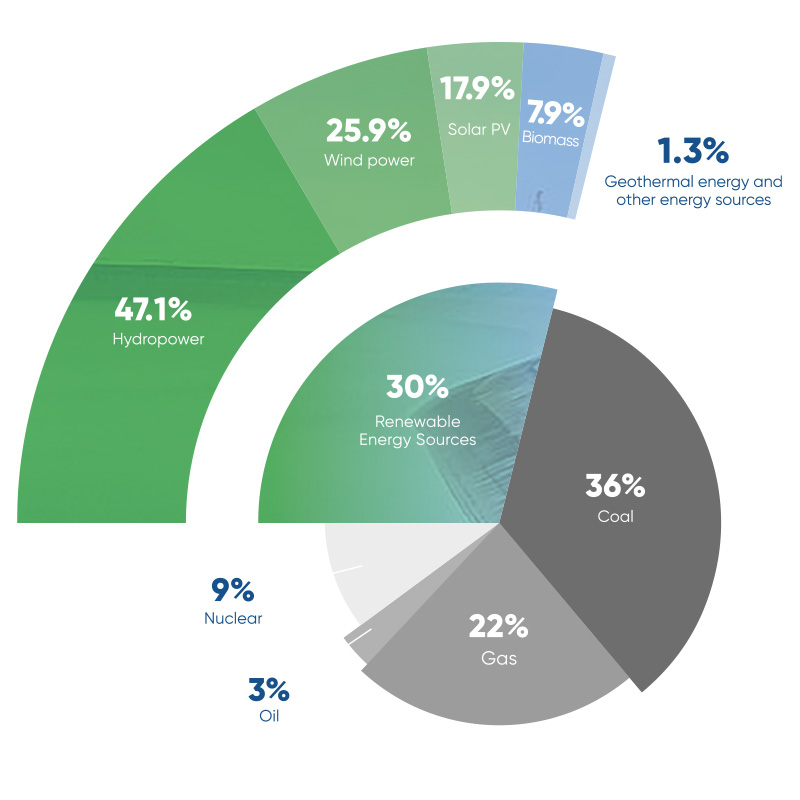
Around 47% of all renewable electricity is generated from hydropower. The sector produces about 14% of total electricity generation from all sources. No country has come close to achieving 100% renewables without hydropower in the energy mix. Hydropower installed capacity reached 1,443 GW in 2024. Global hydropower generation increased by approximately 10% in 2024, rebounding from 4,180TWh in 2023 to 4,578TWh, despite significant drought conditions in Latin America and southern Africa. This growth illustrates the sector’s resilience but also highlights increasing climate-driven variability, which is expected to shape year-to-year performance.
No Smoke. No Carbon.
According to independent research, using hydropower instead of fossil fuels to generate electricity has helped avoid more than 100 billion tons of carbon dioxide in the last 50 years alone.
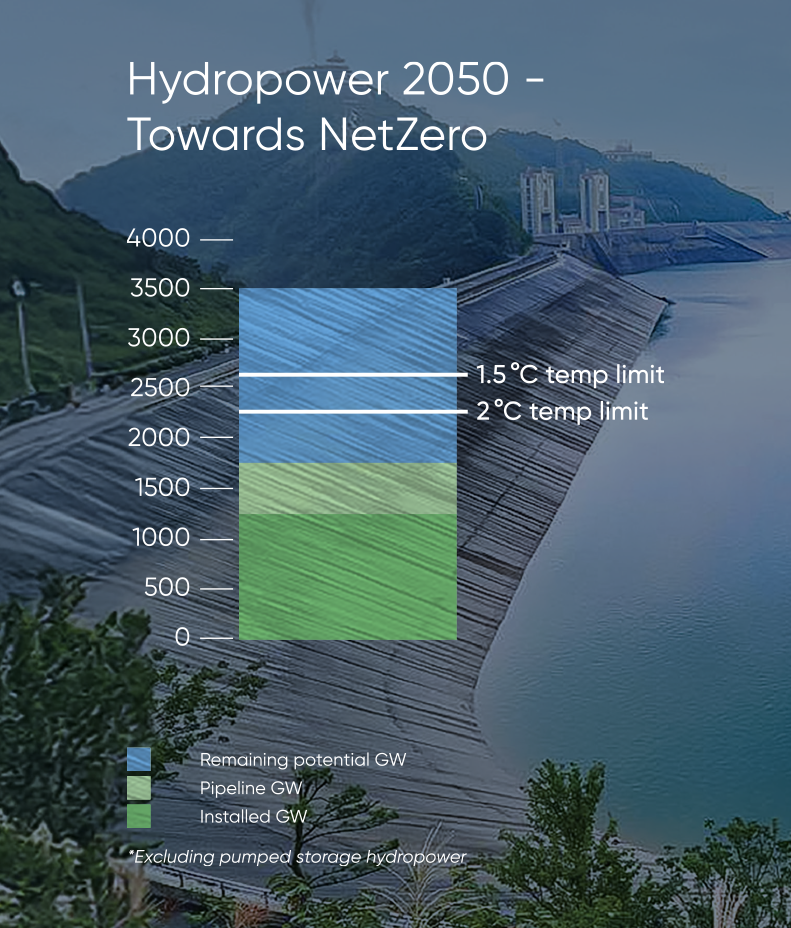
The IEA estimated that 1,300GW of additional hydropower capacity is needed by 2050 to limit the temperature increase to 1.5 degrees Celsius.
Flexible. Balancing.
Hydropower is an optimal balance to variable renewables like wind and solar thanks to its flexibility and energy storage services.
Pumped storage is the world's largest energy storage technology, accounting for over 85% of installed global energy storage capacity, far ahead of lithium-ion and other battery types.
Jobs. Water. Security.
Hydropower does not end with electricity generation. It provides socioeconomic benefits, creates local jobs, supports regional economies, ensures water supply and flood control, and can be used for irrigation and navigation. And hydropower is more necessary than ever as it is key to climate adaptation, offering flexible energy and water storage. Hydropower can deliver greater value from less water.
The hydropower industry employs more than 2.3 million people worldwide directly and many more in related supply chains, accounting for 17% of total power generation employment — the second-largest contributor after solar PV.
Affordable. Economical.
The global weighted average cost of electricity from hydropower projects was US$ 0.057 per kWh in 2023, making it one of the cheapest sources of electricity in many markets.
Sources: IEA, IHA and IRENA
More to explore
HYDROPOWER

Rehabilitation and modernization
The modernization of existing hydropower plants allows an output increase of up to 30%.

ANDRITZ Hydropower in Italy, Schio
The long success story of ANDRITZ Hydropower in Italy began already in 1884.

Synchronous Condensers
With ANDRITZ Synchronous Condensers to a secure and stable grid