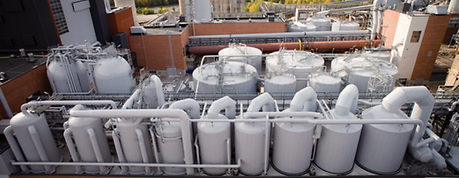
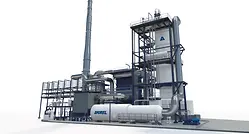
ThioKraft plant

ThioKraft: Sodium-sulfur balance in control with major chemical savings

ANDRITZ SulfoLoop™ sulfur recovery plant uses ThioKraft technology, a new and clear example of what can be achieved at a pulp mill to control the sodium-sulfur balance, at the same time as enabling significant savings in chemical use.

ANDRITZ explores many avenues on its mission to transform pulp mills into truly circular and self-sustaining production powerhouses. It’s latest addition to the SulfoLoop product family, ThioKraft, uses bacteria to convert sulfides from green liquor into elemental sulfur.

The process was originally developed by the Dutch biotech company Paques along with Stora Enso. Paques specializes in biological sulfur removal with its technology being commonly applied in wastewater treatment in the pulp and paper industries. ANDRITZ has recently partnered with Paques to offer the sulfur recovery solution for pulp mill circularity.

ThioKraft plant

ThioKraft plant

HOW ThioKraft TECHNOLOGY WORKS

Controlling the sodium-sulfur balance at a pulp mill is a crucial task and can be expensive when it comes to purging sulfate streams to wastewater and adding make-up chemicals to achieve the perfect result. So, imagine being able to control the required sodium-sulfur balance in the process, and at the same time creating a fully usable side stream of sulfur to make sulfuric acid for the mill’s needs.

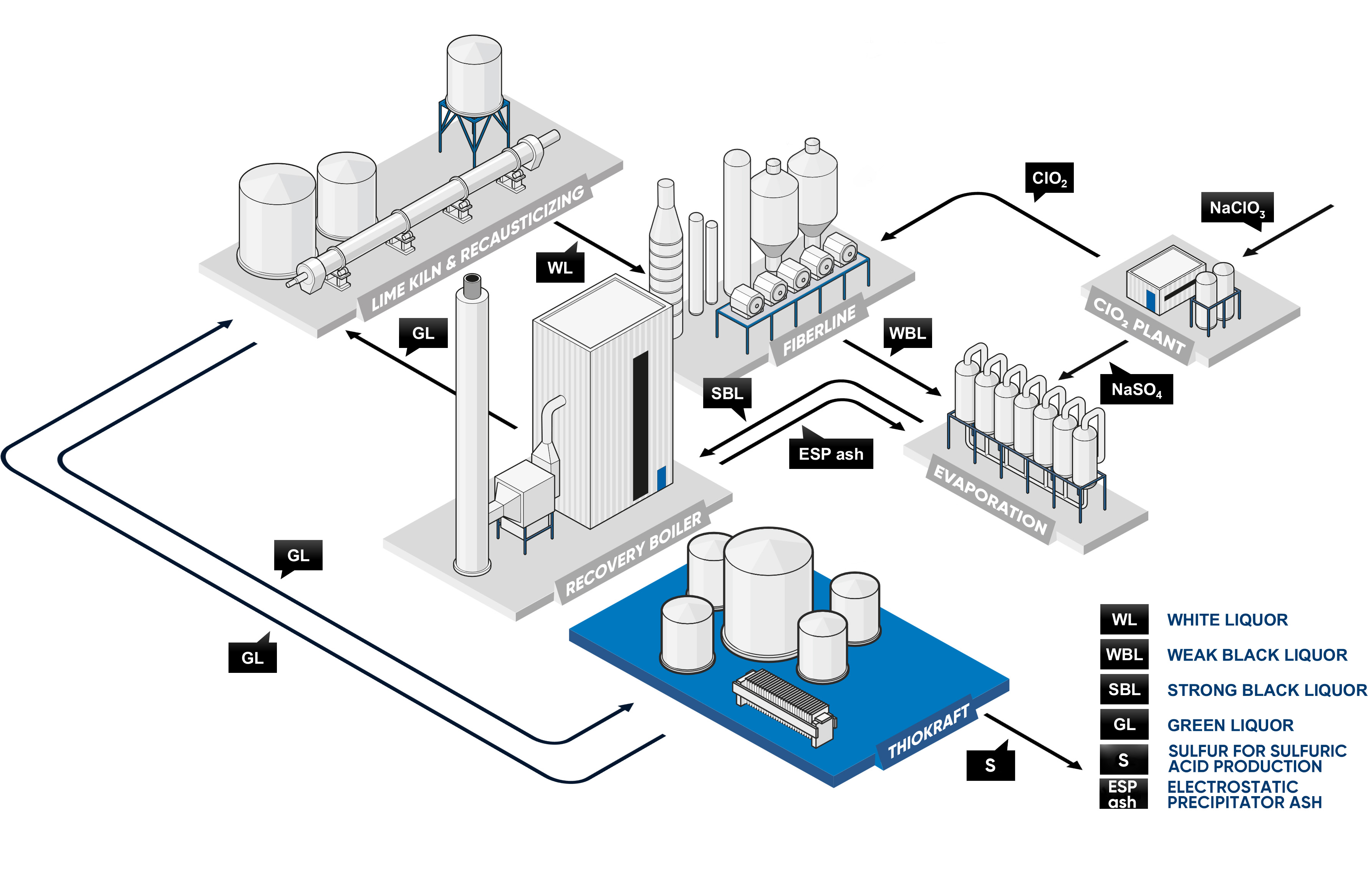
The ThioKraft process is designed to benefit the control of the sodium sulfur balance by extracting only a minor share of the green liquor and removing the sulfur using bacteria in a bioreactor. Bacteria originating from sulfur lakes are able to withstand high salinity and pH. The green liquor is then treated in a bioreactor where the bacteria oxidize sulfide-ions into elemental sulfur, finally producing solid sulfur cakes with a filter press.

Aino Pesola, Development Engineer, Research & Innovation

“In the ThioKraft process, we take just a small percentage of green liquor, enough to optimize the sodium-sulfur balance. In the end the mill needs to add less make-up sodium to the process, or it can use cheaper sodium make-up chemicals, such as sodium sulfate."

Aino Pesola, Development Engineer, Research & Innovation, ANDRITZ

“The green liquor is taken in and introduced to the bacteria, along with air, nutrients, and CO₂ where the sulfide is converted into elemental sulfur.”

After the conversion process the treated green liquor goes back to the mill and the sulfur slurry is pressed into a solid form.  

SYNERGIES WITH THE SulfoLoop SULFURIC ACID PLANT

ThioKraft can run alongside ANDRITZ’s SulfoLoop sulfuric acid plant. The sulfuric acid plant only removes some 4 kg of sulfur per ADT of pulp from concentrated non condensable gases (CNCG) without additional process steps. For the sulfur recovery plant, there is no technical limit for the sulfur extraction, which can be very useful, for example, in mills investing in lignin recovery.

Sulfur recovery plants are economically viable even at small pulp mills, unlike sulfuric acid plants, which need larger scale. Ideally, multiple nearby mills would host sulfur recovery units feeding one central sulfuric acid plant. Alternatively, adding sulfur recovery enhances flexibility in mills expanding capacity or investing in processes like lignin recovery.

Pesola explains, “With ThioKraft, as long as the sulfuric acid plant is designed to run complementary with elemental sulfur, the mill can, in future scenarios, take more sulfur out of the cycle and replace part of the purchased elemental sulfur with internally produced sulfur.”

The ThioKraft system utilizes not just green liquor from the mill, but also CO₂ from the flue gases. In addition, the system can use mill internal liquid streams instead of fresh mill water. “Obtaining CO₂ from the lime kiln is another advantage of the ThioKraft system as it closes more loops and avoids the cost of acquiring CO₂ elsewhere,” adds Pesola.

FROM DEEP RESEARCH INTO OPPORTUNITY AND FINAL PRODUCT

ANDRITZ has deeply researched the opportunity ThioKraft technology represents in the pulp process and has worked with Paques on utilizing the technology. Pesola concludes, “We have recently signed an agreement with Paques and we can now offer the technology under our SulfoLoop brand of products. Basically, Paques will supply the technology license and core equipment, and ANDRITZ does the rest, installs the technology, and optimizes the process.”

A SulfoLoop sulfur recovery plant using the ThioKraft process is part of ANDRITZ’s CircleToZero™ product portfolio, which focuses on eliminating unused side streams, creating new added value products, and laying a foundation for zero emissions and zero waste production.

A view looking straight up from the base of A-ConApex reactor, with the sun on the right.

Pulp Mill of Tomorrow – Today, with ANDRITZ

Transform your pulp mill into a full-scale biorefinery.

Find out more
CircleToZero_Forest
© Adobe Stock

Circle To Zero - towards zero emissions and zero waste

CircleToZero is an initiative to provide future-proof solutions for our customers to reach their zero emissions and zero waste targets to produce their pulp and paper products.CircleToZero combines the development of new technologies, the implementation of digital solutions, and the utilization of side streams with the target to create financial value while lessening their environmental footprint towards zero.

Explore
aa-pulpandpaper-white-liquor-plant

Automation for the pulp and paper industry

Optimization, data analysis, augmented reality

Read more
ANDRITZ service experts and customers

Pulp & Paper

Comprehensive service to support customer processes: from replacement parts to complete mill maintenance...

Pulp & Paper service
TuneIn-Podcast_1

Listen to experts!

We bring together the trends, challenges and solutions that matter most to customers.

LISTEN NOW!
SPECTRUM

Recommended readings

Success story of Increasing automation level at Metsä Fibre Äänekoski
© Walberg Media

Metsä Fibre Äänekoski stabilizes plant operations and improves its performance significantly with ANDRITZ SYNERGY™ Services agreement

Metsä Fibre and ANDRITZ established a long-term optimization partnership through the ANDRITZ SYNERGY™ services concept. Combining smart instrumentation with digital solutions and strong process expertise, the collaboration created a structured framework for continuous performance improvement across the operation.

Bäckhammar woodyard_IMG_5131_ANDRITZ

Bäckhammar mill’s new high-tech woodyard

Nordic Paper’s Bäckhammar pulp mill in Sweden has completed a transformative upgrade to its woodyard – the largest single investment in the company’s history. The result is a state-of-the-art wood processing line, supplied by ANDRITZ, powered by Smart Solutions for the wood processing line and long-term service contracts for the highest chip quality, low water consumption, and long, trouble-free lifetime. 

Essential in a volatile world - Defossilizing pulp mill lime kilns

De-fossilizing of lime kilns

In a world of increasing oil and gas volatility in supply and pricing, ANDRITZ defossilizing technologies deliver fast, reliable fossil-free operation and provide an economical solution to one of the most energy-intensive processes in pulp mill operations.

AdobeStock_369206916
© Space Creator - stock.adobe.com

ANDRITZ BioCircleToZero PROGRAM sees new development projects

In a vital effort to double the value of wood being utilized at pulp mills, last year ANDRITZ launched the BioCircleToZero program. The initiative is already gaining significant pace with three ongoing development projects launched: SAUNA, H2ELP, and CirBRes. 

Rendering for Technews part

HyperFlaker

Traditional deflakers are a well-known technology. After decades of optimization, the state of the art no longer had much room left for improvement. Put simply, classical deflakers had been around for a long time, and had gotten just about as good as they were going to get.

Evaporation plant at the UPM Paso del los Toros mill in Uruguay
© Behrendt

High-end evaporation boosts process availability of the whole pulp mill

Pulp mill processes need to be continuous as well as cost and energy efficient. The evaporation process plays a critical role here. How do ANDRITZ evaporation solutions truly address these needs?

Metal 3D printing with welding robot

3D Printing - One layer at a time

Reinventing the repair service approach: WAAM. ANDRITZ has been working hard behind the scenes with the latest technologies to revolutionize the approach to repair of expensive cast parts in the pulp and paper industries. Now, utilizing Wire Arc Additive Manufacturing (WAAM), it is possible to dramatically shorten the cost of heavy cast equipment repairs, shorten downtime, and improve environmental performance.